

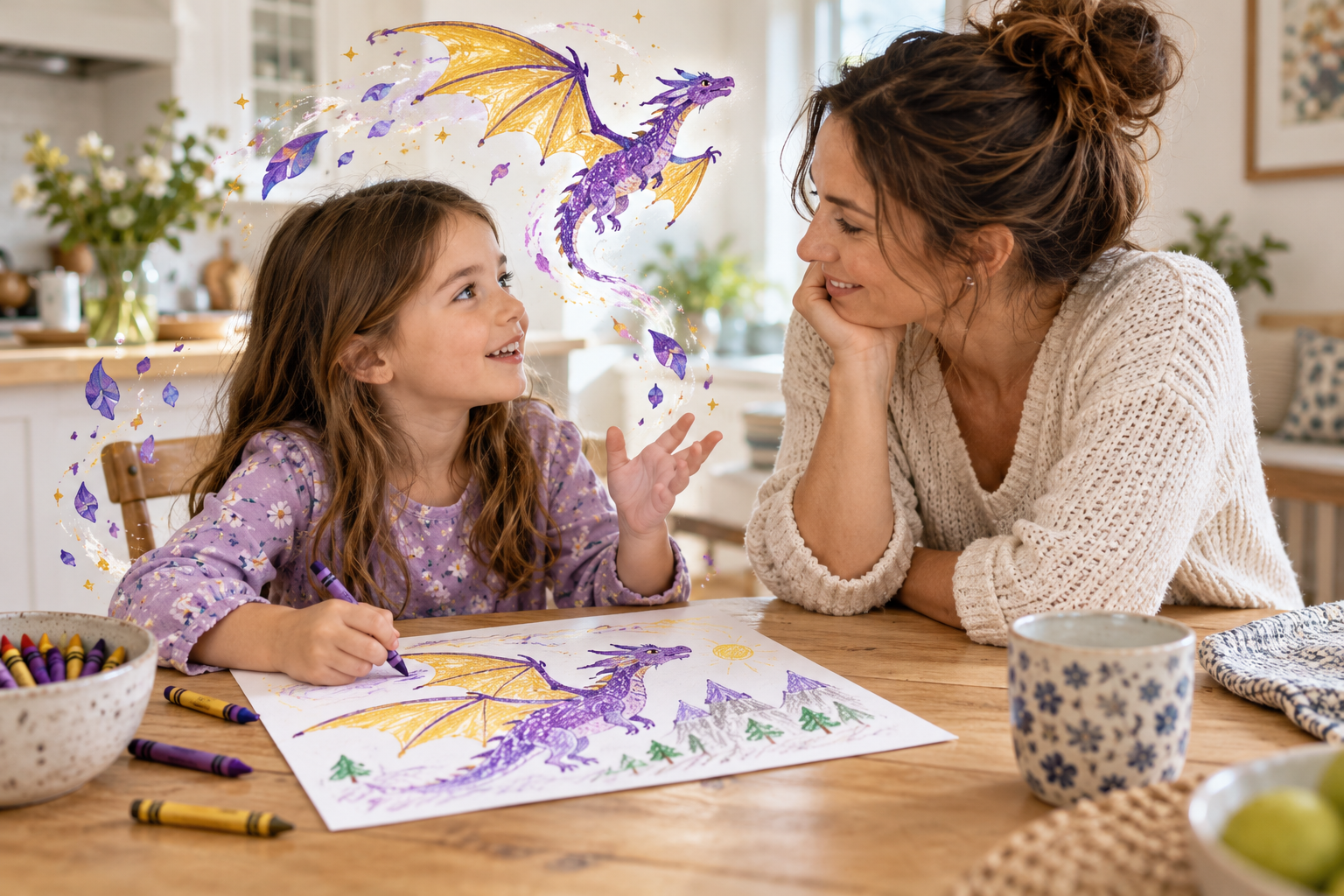
What a Halloween dragon can teach us about reading comprehension and expressing ideas.
Your child reads a page aloud. The words sound right. The sentences flow. Then you ask, “What happened in the story?”
“I don’t know.”
You might wonder: Were they paying attention? Should we read it again? How can they read it so well without understanding it?
Reading the words and understanding their meaning are connected skills, but they are not the same. A child may recognize words accurately while still having difficulty making sense of the message. Speech-language pathologists look at both spoken and written language because understanding and expressing language are closely connected to literacy.
Sometimes, an everyday conversation offers a helpful way to understand that connection.
“I Want to Be a Dragon!”
Imagine asking your child what they want to be for Halloween.
“A dragon!”
Wonderful. You’re ready to find the costume—or dust off your craft supplies.
“What should your dragon look like?”
“A dragon.”
“Do you want wings? What color? Does it have spikes?”
“I don’t know. Just a dragon!”
You may be imagining a friendly green dragon with little wings. Your child may be thinking of an enormous red dragon with silver horns and a tail that practically needs its own parking space.
Or your child may not have worked out those details yet.
Naming an idea is different from developing it and describing it clearly enough for someone else to understand.
To explain the costume, your child needs to think about its features, choose descriptive words, organize those details, and consider what you need to know.
That is a lot of language hiding inside one Halloween question.
What Does This Have to Do With Reading?
The dragon example offers a useful parallel.
When describing a costume, a child moves from an idea toward words:
“What am I imagining, and how can I explain it to you?”
When reading, a child moves from words toward meaning:
“What is the author describing, and how do these details fit together?”
Consider this sentence:
The little dragon tucked its torn wings beneath a wet blanket and shivered outside the castle gate.
A child might read every word correctly. Understanding the scene requires more: connecting the details, knowing what the words mean, and thinking about what the sentence suggests.
Is the dragon comfortable? Probably not.
What tells us that? The wet blanket and shivering.
Might it need help? What in the sentence supports that idea?
These connections help turn a string of words into a meaningful scene.
Imagining, Understanding, and Putting Ideas Into Words
For some children, imagining a scene helps them connect and remember details. Describing that scene can help them organize their thinking and show what they understand.
You might think of it as building meaning and then putting that meaning into words.
However, difficulty describing a dragon does not automatically mean a child has difficulty forming mental images or understanding reading. They may need help with vocabulary, finding words, organizing ideas—or simply deciding what kind of dragon they want.
Children also differ in how vividly they picture things in their minds. A vivid mental picture is not a requirement for understanding a story. Pictures, discussion, gestures, and other supports can also help children build meaning.
The important question is whether your child can understand ideas, connect details, and communicate their message—not whether they describe their imagination in one particular way.
Try It at Home: Design the Dragon Together
Instead of asking a long series of questions, start with one manageable detail.
Offer a choice.
“Are you imagining a tiny dragon that sits on your shoulder or a huge dragon taller than our house?”
Add a feature.
“What color is it? Does it have smooth skin, scales, or fur?”
Give the detail a purpose.
“Does it use its wings to fly, or are they too small?”
Model a description.
“My dragon is purple with golden wings. It looks fierce, but it is afraid of butterflies.”
Put the details together.
“Let’s tell someone else about your dragon so he can imagine it, too.”
Drawing the dragon or choosing pictures together can take some pressure off speaking. You can help supply a word when needed: “Those sharp things along its back could be called spikes.”
Keep it playful. This is a conversation, not a test.
Bring the Same Approach to Books
After a short passage, try one or two prompts:
“What is happening in this part?”
“Which words helped you figure that out?”
“How do you think the character feels? What gives you that idea?”
“Can you draw it, act it out, or explain it to me?”
If your child is unsure, model your own thinking:
“I think the dragon feels cold because the author says it is shivering. The blanket is wet, so it probably isn’t helping much.”
Then give your child time to respond. The goal is to help them connect meaning, rather than remember isolated details just to answer questions.
When Is It Worth Asking for Help?
One brief answer about a costume is not a reason to worry. Look for patterns across everyday conversations, listening, reading, and schoolwork.
A child may benefit from a closer look if they frequently struggle to explain ideas, retell events in order, understand what they hear or read, or give enough information for someone else to follow. Spoken-language difficulties and reading difficulties can occur together, which is why looking across these activities matters. ASHA: Written Language Disorders
Talk with your child’s teacher about what they notice. A speech-language evaluation can help clarify whether language skills are contributing and what support may be useful.
Helping Children Understand—and Be Understood
At Coastal Orofacial Wellness, I help children strengthen language, communication, and reading skills through individualized support. That may include building vocabulary, organizing descriptions, retelling stories, and connecting details to meaning.
In-home services are available in Martin and Palm Beach counties, with virtual therapy available for Florida families.
If your child can read the words but struggles to explain the meaning—or has wonderful ideas that are difficult to put into words—a complimentary 15-minute phone consultation is a place to start.
Visit coastalorofacialwellness.com or call 772-485-0669.
Breathe better, speak clearly, read confidently, and thrive.
